
Introduction
Read the introduction
Mobility might be a bit of a difficult word, but it refers to how each of us gets around. Sometimes it’s by car, other times by bike or on foot, and sometimes by public transport.
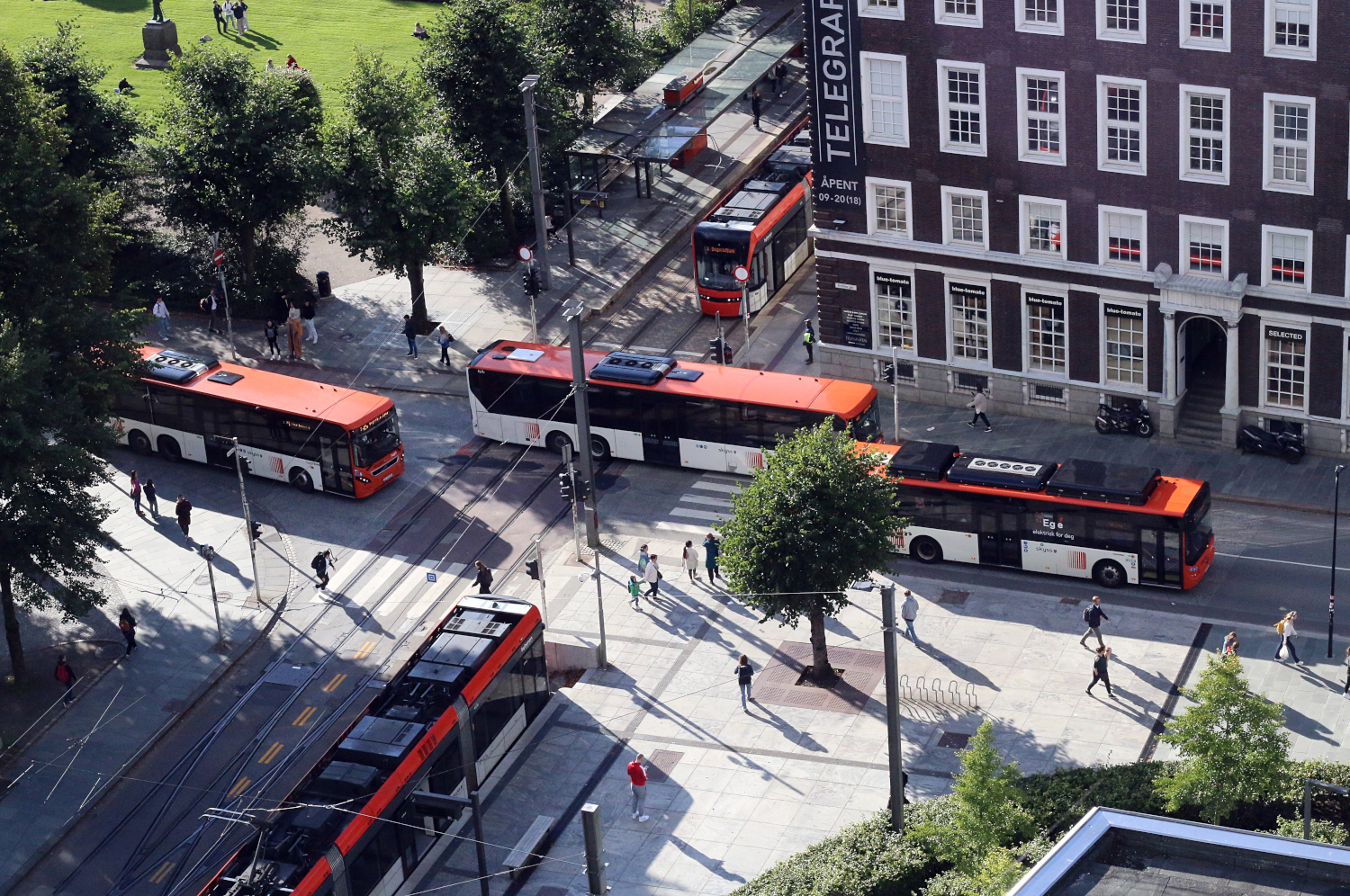
A well-functioning mobility system is one where people can easily get to where they need to go, efficiently, when they need to. The fixed, scheduled public transport options—such as buses, boats, ferries, and light rail—serve as the backbone of this system.
Increasing transportation needs in urban areas put pressure on infrastructure—traffic jams, to put it more colloquially—and also challenge land use in both cities and towns. Therefore, a lot can be gained by developing public transport services and also by facilitating more walking and cycling in everyday life.
In areas with high demand for public transport, there is broad professional agreement that public transport networks should be built, rather than thinking of public transport as just a collection of individual routes. It’s important to have a high number of departures, and it’s crucial to have good hubs for efficient and easy transfers. This has been the starting point for several route reorganizations in the Bergen area in recent years. In Skyss’s annual report for 2024, you can read about the good results in the Bergen area. Particularly, the development for the light rail is worth mentioning. From 2023 to 2024, it saw a growth of six percent, with the «little brother» —line 2 to Fyllingsdalen—showing the most significant increase.
In the annual report, you will also find much more, including information on new purchasing solutions, on how the passengers and the population at large perceive our services, on our energy and climate work, and how we handle contracts and demand-responsive services. At the same time, you will gain insight into some of the challenges faced by public transport, including increasing costs. We wish you a pleasant read.
Målfrid Vik Sønstabø
director, Skyss
Public transport in 2024
On weekdays in 2024, there was an average of 306,000 daily boardings on buses, light rail, and boats in Vestland County. In total, there were 92.7 million boardings throughout the year.
More than nine out of ten public transport journeys in the county (85.4 million boardings, or 92 percent) took place in municipalities covered by the urban growth agreement for the Bergen area. It was also in this area we saw the largest growth from 2023. If we consider the combined bus, light rail and city boat network, the growth rate was at 4 percent. Within the urban growth agreement area, there were no less than 1.7 million more boardings on buses in 2024 as compared to 2023, and as many as 10,000 more daily boardings.
The Bergen Light Rail – a Continued Success
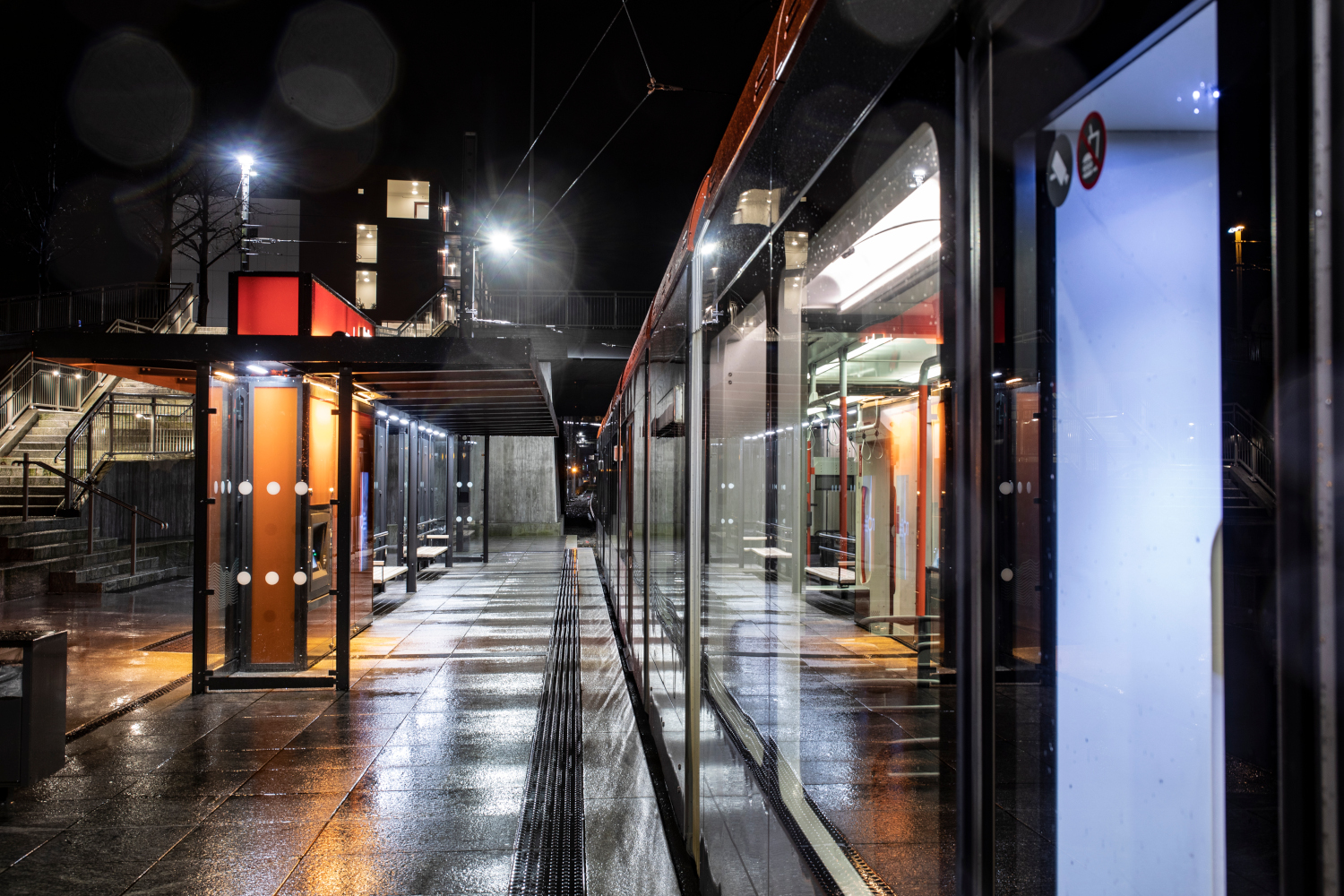
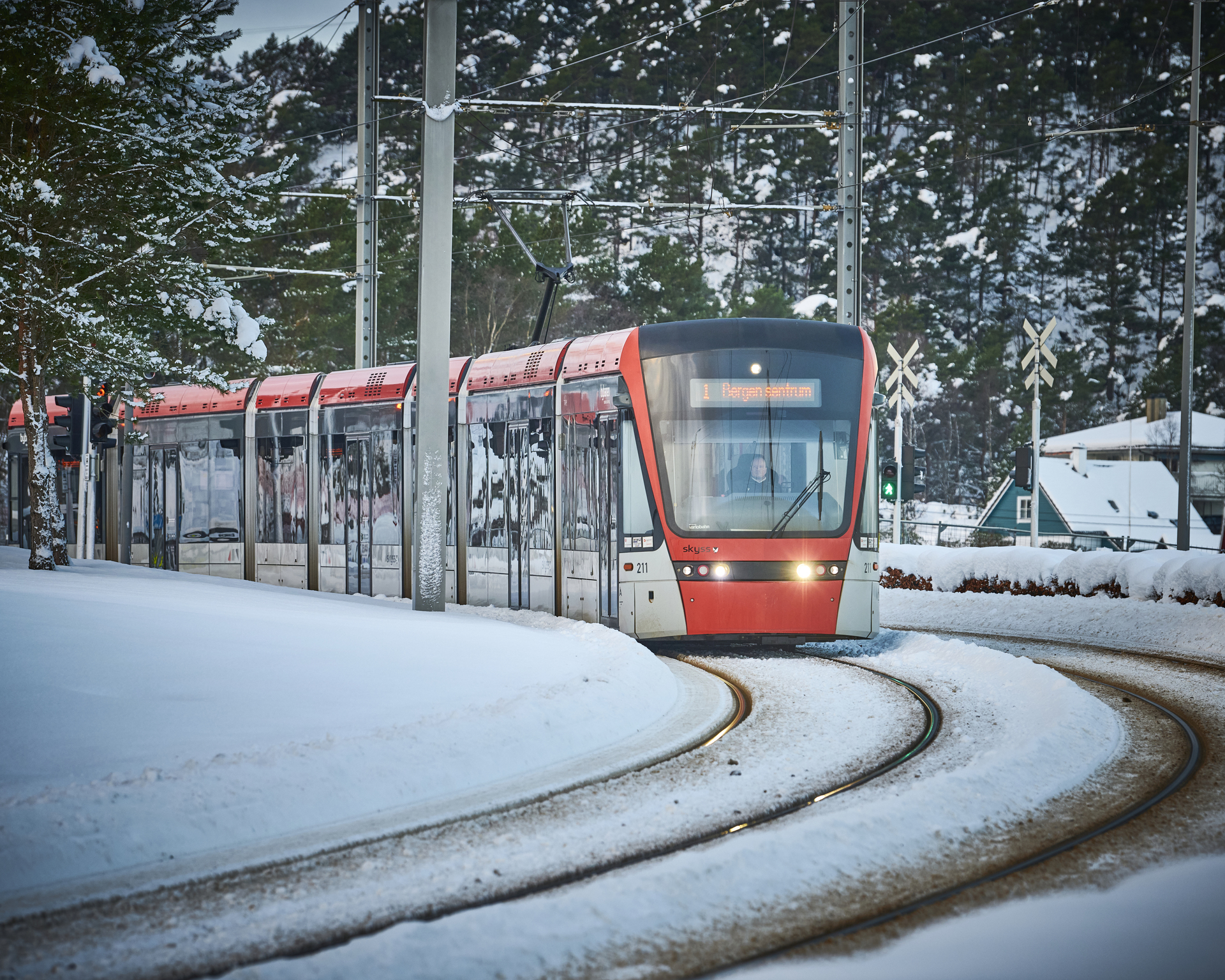
The Bergen Light Rail plays a key role, and saw the highest increase. In 2024, there were 25.9 million boardings on the light rail, compared to 24.3 million the year before. This represents an increase of 6 percent.
Both of the light rail lines have gained more passengers. The highest increase can be seen on line 2, running between the Bergen city center and Oasen / Fyllingsdalen. In 2024, line 2 saw 5.8 million boardings, as compared to 4.9 million boardings the previous year; a 16 percent increase. Line 1, running between Bergen city center and the airport, exceeded 20 million boardings for the first time, compared to 19.3 million in 2023, representing an increase of 4 percent.
The light rail provides high capacity, combined with low energy consumption, low operating costs and high regularity, placing it as the backbone for public transport in Bergen. In 2024, it accounted for 28 percent of all journeys done by public transport in the entire county of Vestland. The light rail also has a significant impact on traffic patterns in the Bergen area, and plays an important role in relieving road congestion. On average, there are around 62,000 boardings per weekday on Line 1 and about 18,000 on Line 2.
On several individual days in 2024, there were over 100,000 boardings on the two lines combined. One of these days was May 17 – the Norwegian national day, when Line 1 had over 80,000 boardings, and Line 2 had nearly 25,000.
Million boardings per year. Line 2 opened on 21 November 2022.
Show the data behind the chart
| Year | Line 2 | Line 1 |
|---|---|---|
| 2020 | 0.0 million | 12.4 million |
| 2021 | 0.0 million | 13.9 million |
| 2022 | 0.5 million | 18.6 million |
| 2023 | 4.9 million | 19.3 million |
| 2024 | 5.8 million | 20.1 million |
Stable Passenger Numbers for Boats
The boat routes in Vestland had nearly 1.8 million passengers in 2024, an increase of 2 percent from the previous year. The Bergen–Nordhordland route had 157,000 boardings in 2024, compared to 164,000 in 2023. This is a slight decrease, but it can be seen as a stabilization after record growth the previous year, when the boat was first included in Zone A (like buses and the light rail), making tickets cheaper.
The Bergen–Askøy route saw an increase of 4 percent, from 657,000 boardings in 2023 to 685,000 in 2024.
Increased traffic on county road ferries
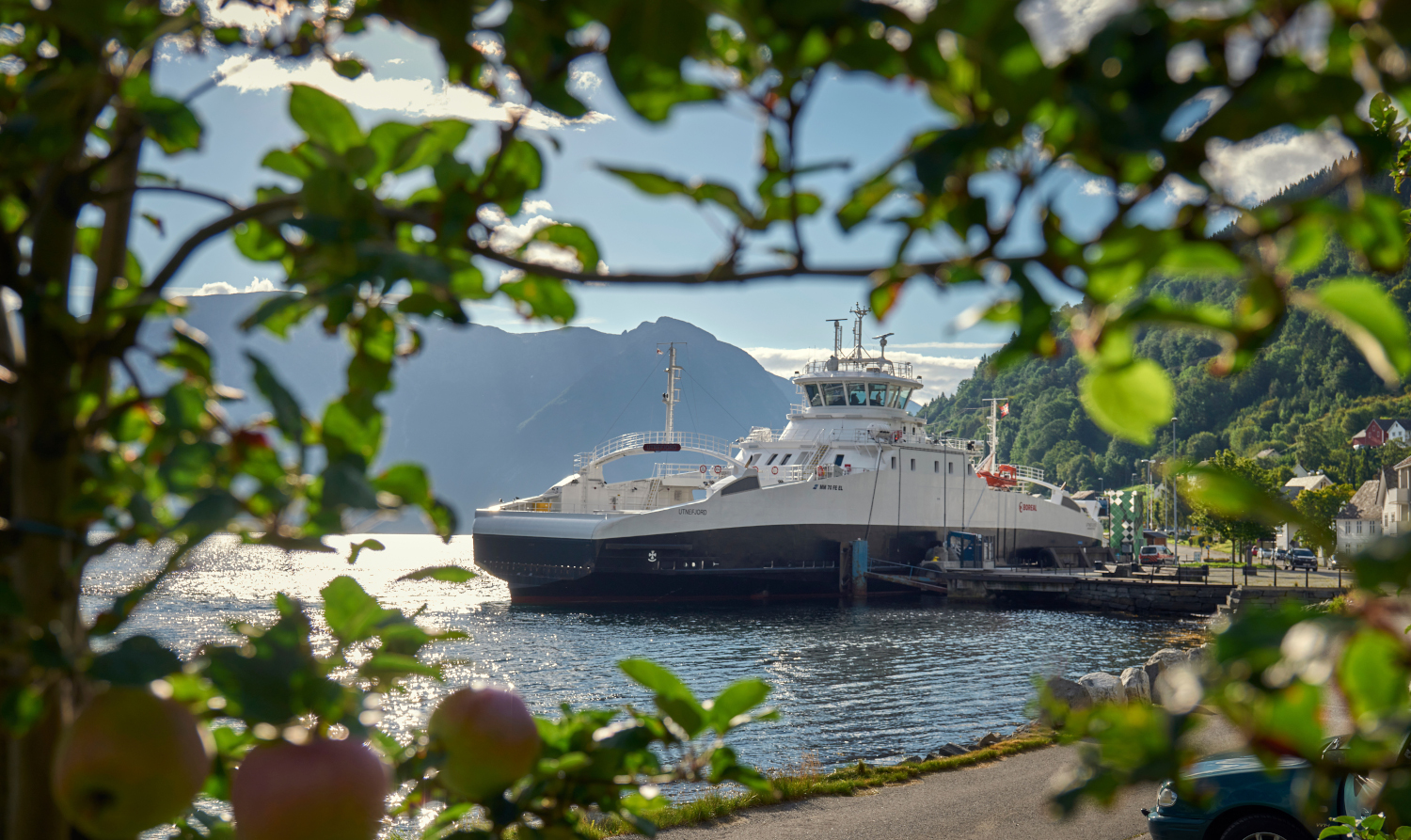
On county road (fylkesveg)ferries, the number of vehicles increased by 3 percent, and traffic increased across all county-operated ferry connections. In 2024, there were 3.2 million vehicles transported by ferries, or nearly 4.5 million passenger car units. These ferries are of great importance both for local communities and for regional transport.
The Norwegian Maritime Authority has tightened its practice for granting exemptions from rest time regulations for ferry crew members. Their updated practice means that ferry operators cannot use staff who have recently completed a shift to cover vacancies that arise, for example, due to illness.
Unfortunately, this new practice has led to a number of short-time service interruptions, and have affected regularity. Emergency ferry routes are particularly vulnerable, as unplanned trips lead to crew members then having to observe the mandatory rest periods.
Additionally, the industry is facing challenges in recruiting staff, a problem not limited to Vestland. Recruitment for engine room operators has been particularly difficult. This has also led to cancelled departures due to a shortage of crew. However, it is important to emphasize that the industry has worked hard to resolve these staffing shortages, and the overall regularity exceeded 99.5 percent in the fourth quarter of 2024.
Increased costs, increased prices
While 2024 was another year of growth for public transport in Vestland County, we have also faced several challenges. One of these is the increased cost of public transport. Over the past few years, operating expenses for public transport i Vestland county have increased by roughly half a billion kroner. State subsidies meant to cover these costs have grown much less.
The increasing expenditure is a nation-wide issue with complex causes. On one hand, the general economical development plays a role, many goods and services have increased in prices in recent years, and increased expenses for fuel and personnel also impact buses, light rail, boats, and ferries. At the same time, the transition to more environmentally friendly fuels comes at a price, both in terms of investments in new infrastructure and in terms of more expensive equipment.
Most years, the ticket prices of Skyss are adjusted on February 1. In 2024, they were also adjusted on August 1, based on a decision by the county council on June 19. In August, the price of a single ticket for buses, light rail, and fast boats increased by three kroner, while the price of a period ticket for one zone increased by ten kroner. The price of a single ticket (for bus and light rail) consequently became 47 kroner. In reality, many travelers saw lower prices for single tickets due to the travel discount scheme introduced on February 1.
Issues in Florø
2024 has also been a year with other challenges. On May 1, a new contract started for boat traffic between Florø and a number of islands, as well as for a local route in Sognefjord further south (Vik–Ortnevik–Nordeide). In the months since, there has regrettably been a number of issues. In the Florø area, the main problem has been delays, affecting both work and school commutes. As a temporary measure, an additional boat was introduced, financed by the operator, Norled. Then changes were made to the morning routes between Florø and the islands, primarily to ensure that schoolchildren arrived on time for school. While this solved some problems, delays remain a problem. Skyss is not satisfied with the delivery, and has continuously followed up with the operator. However, Skyss and the operator has different assessments of the causes behind the delays.
Regularity for the boat routes to the islands outside of Florø has generally been good. In December, however, route 292 saw a relatively high number of cancellations, causing further frustration and difficulties for travelers.
The Vik–Ortnevik–Nordeide route has also faced significant delays and cancellations. The main reason is challenges in establishing charging stations in the area, due to both power grid limitations and lack of available space. As a result, the boat operating on this route has not had access to charging as originally planned.
Emission Cuts in New Contracts
In 2024, Skyss awarded several new contracts. In April, contracts were awarded for bus transport in the regions of Hardanger/Voss, Modalen/Vaksdal, and Nordfjord. These contracts last for ten years, starting in June 2025, with the possibility of a three-year extension if operators are able to reduce greenhouse gas emissions by 90 percent.
All three contracts focus on significant emission reductions through a transition to electric buses.
In December 2024, Skyss awarded three ferry contracts, covering several routes. All of them has a start up in November 2027. These contracts also set environmental requirements, including fully electric operations for certain routes and hybrid solutions for others. Skyss estimates that emissions cuts from these contracts will be around 65-70 percent compared to current operations.
School Transport
Skyss is responsible for school transport, a legally mandated service to ensure equal access to education regardless of financial background, physical conditions, place of residence, or geography. At the end of 2024, approximately 20,300 primary school students in Vestland had been granted free school transport.
In and around Bergen, high school students primarily use the 30-day youth ticket for school transport. In the rest of the county, around 5,000 high school students were granted free school transport.
Skyss maintains close dialogue with municipalities and schools to coordinate routes and schedules for the most efficient and practical service possible. However, several societal factors are making school transport more complex and less efficient. Among the factors that most significantly affect the need and costs for school transportation are the increased degree of transportation for students with shared residences and various custody arrangements. The inclusion of more children with significant disabilities in schools, changes and centralization of school structures in municipalities and counties, more private schools, and greater variation in schedules
New ticketing solutions
New Discount Scheme
February 1, a new discount scheme for bus and lightrail travel was introduced. In the Skyss ticket app, adults purchasing single tickets receive an increasing discount based on how many tickets they buy within 30 days.
In recent years, our travel habits have changed. Many people have varying daily routines, and do not use public transport frequently enough to make a period ticket worthwhile. The new discount scheme seeks to cater to this group, giving them an incentive to choose travelling by public transport rather than going by car.
Before being introduced, the discount scheme was tested in a pilot program including 1,000 travelers in Zone A under the name «flexible ticket.» After receiving very positive feedback from the test group, the county council decided to implement the scheme and expand it to cover all zones. As a result, all adults purchasing single tickets through the app receive a discounted price starting from their second ticket purchase within a month. The maximum discount was initially 40 percent but was reduced to 30 percent as of February 1, 2025.
The goal of the scheme is to make it easier for people to leave their cars at home, even if they do not travel frequently enough for a period ticket to be cost-effective.
Harmonization of Boat Prices
On October 1, 2024, new prices and a common discount scheme were introduced for Skyss’ boat routes in Vestland. In order to provide uniform and fair pricing throughout the county, prices were standardised for journeys of the same distance, and discount rules were made consistent across the entire region. This means, among other things, that children under six years travel for free and that child tickets apply up to the age of 17.
The Askøy boat, the Nordhordland boat, and local boat routes from Florø to the surrounding islands are part of the zone structure for buses (which also includes the Bergen Light Rail) and were therefore not included in this restructuring.
New Payment Solution for Businesses
As part of our efforts to simplify and improve purchasing solutions, Skyss has been developing a payment solution for businesses and organizations wishing to cover public transport costs for their employees, clients and others. This solution was initially launched for selected businesses and organizations in 2023 and was expanded to the entire market in 2024. With the new payment system, businesses can be invoiced directly, eliminating the need for traditional travel expense reimbursements.
New Solution for School Transport
The ticketing system for school transport has traditionally involved many manual processes. In 2022, Skyss conducted work to identify challenges and needs, and to explore how the system could be improved.
This led to a pilot project with a mobile phone-based school transport ticket, carried out in January and February 2023. From the start of the school year in autumn 2023, high school (videregående skule) and middle school (ungdomsskule) students with free school transport were given the option to receive their ticket in our ticket app.
Based on feedback from parents and political signals, however, this option was not extended to children in elementary school (barneskule). Instead, in 2024, Skyss introduced a new card-based solution for younger students and for those older students who opt not to use a mobile ticket. They now receive a school transport card with a digitally stored ticket. Students can use the same card throughout their schooling, instead of receiving a new one each year. This simplifies their daily routine while also reducing administrative work for the schools, as well as for Skyss.
Collaboration with Others
On January 1, 2024, Ruter AS — the public transport authority for Oslo and Akershus — placed all their activities related to digital service development into a new company, Tet Digital AS. This was done with the intention of developing and providing deliver digital solutions to multiple county municipalities and public transport companies.
Initially, Ruter AS was the sole owner of Tet Digital. In December 2023, the Vestland County Council decided to join the company as a shareholder, a decision formally completed in March 2025, when Agder Kollektivtrafikk also joins as a co-owner. The new company will develop digital services and customer interfaces for all its owners and will play a significant role in making it easier to pay for and use Skyss services in the future.
Demand-responsive bus services
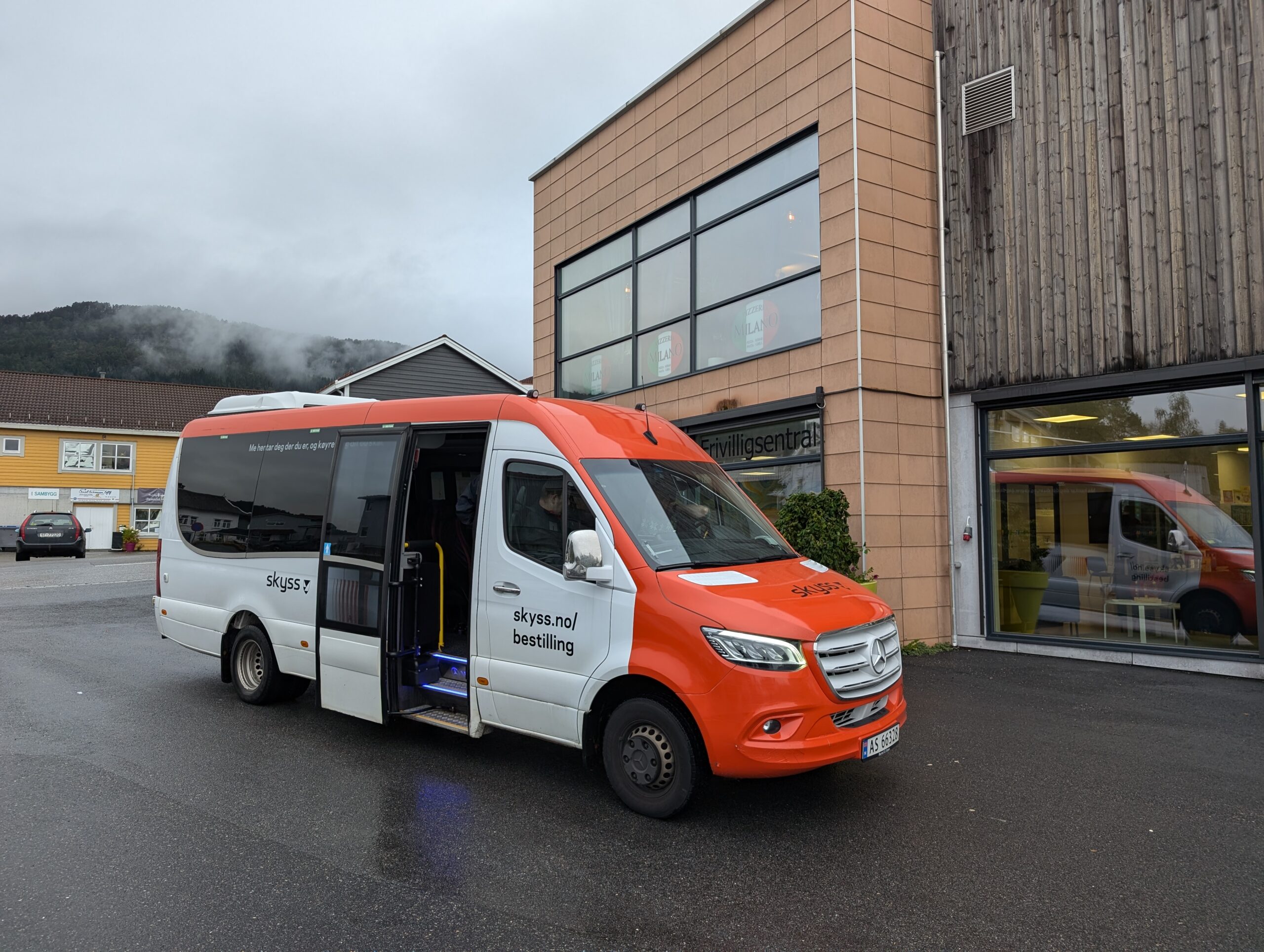
For some years, Skyss has been testing demand-responsive transport based on digital technology and flexible services. In 2024, more municipalities received such services through the early launch of on-demand transport options that will be part of bus contracts starting in 2025.
In October 2022, Skyss launched a pilot project with an on-demand bus service in Tertnes. In Tertnes and areas around central Åsane, you can — on weekdays during daytime — be picked up where you are and be driven to your destination with a regular bus ticket.
You can book the service via an app, a website, or by phone. An app used by the driver plans the route based on booked trips, allowing multiple passengers to travel together if they have booked within the same time frame. In 2024, the service in Tertnes was used by 13,689 passengers across 8,576 trips. The average cost per passenger was 152 kroner, though at times it was as low as 110 kroner. The average cost per trip was 236 kroner.
New On-Demand Buses in 2024
In September 2024, Skyss launched on-demand transport services in the rural municipalities of Samnanger, Kvinnherad, and Masfjorden. These are not test projects, but rather early implementations of services included in the new bus contracts starting in 2025.
These contracts include over 50 on-demand transport services. The three mentioned municipalities have contributed their own funds, which has expanded the scope of available services. This is particularly evident in Samnanger, which allocated two million kroner to on-demand transport, aiming to cover the entire municipality extensively. This level of coverage would not have been possible without municipal funding.
The service has quickly gained many loyal users who travel several times a week. Due to Samnanger’s geography, a rule has been introduced requiring the minibus to pass through central parts of the municipality during each trip. This allows for more passengers being picked up along the way, and increases the number of share rides, thereby reducing the number of kilometers driven, costs, and emissions. Over the last four months of 2024, more than 1,200 passengers were transported on over 850 trips, covering over 8,000 passenger kilometers.
In Masfjorden, the service is open to everyone, yet particularly tailored to those over 67 years old for essential trips to the municipal center, Hosteland. The service has a small group of regular users but still has available capacity. It initially covered five routes but has since been adjusted to three areas. Users are very satisfied with the service, and the Skyss and the municipality are working together with the local health association and with volunteers to recruit more passengers.
In Kvinnherad, the municipality contributed two million kroner. The on-demand service is limited to central areas of Husnes, which hosts many of the municipality’s service facilities, transport hubs, and other key locations. The service has been well received, and usage has increased significantly after a cautious start. Over the last four months of 2024, nearly 1,700 trips were completed, transporting 2,629 passengers over 10,500 passenger kilometers. The service is delivering strong results both financially and in terms of passenger numbers, with one of the highest ride-sharing rates in the country.

Population and traveller satisfaction
Through the Kollektivbarometeret / Benchmarking in European Service of Public Transport (BEST) survey, we obtain data showing how satisfied the population is with various aspects of public transport.
This survey allows us to measure the development of satisfaction with public transport in our own region while also enabling comparisons with other areas. Respondents are asked to evaluate a series of statements, and the percentages shown below represent those who completely or partially agree with the statements.
When comparing public transport in Vestland with services in other parts of Scandinavia, Vestland county scores high on punctuality and perceived safety, and we also perform well in terms of value for money.
Share of the population who fully or partially agree, percent
Source: Kollektivbarometeret / BEST 2024.
Show the data behind the chart
| Index | Vestland | Helsinki | Copenhagen | Oslo / Akershus | Stockholm | Trøndelag | Rogaland |
|---|---|---|---|---|---|---|---|
| The public transport offer | 60 % | 75 % | 61 % | 73 % | 64 % | 61 % | 55 % |
| Punctuality | 80 % | 75 % | 57 % | 58 % | 49 % | 66 % | 63 % |
| Information | 58 % | 69 % | 53 % | 58 % | 52 % | 58 % | 59 % |
| Staff behaviour | 83 % | 71 % | 74 % | 74 % | 66 % | 80 % | 71 % |
| Safety | 84 % | 78 % | 71 % | 82 % | 70 % | 82 % | 78 % |
| Comfort | 72 % | 79 % | 62 % | 67 % | 62 % | 73 % | 66 % |
| The role of public transport in society | 75 % | 76 % | 65 % | 80 % | 75 % | 77 % | 73 % |
| Value for money | 53 % | 57 % | 33 % | 44 % | 35 % | 45 % | 50 % |
| Population satisfaction | 55 % | 75 % | 50 % | 65 % | 61 % | 54 % | 48 % |
For several of the indicators, the percentage is based on the average value from multiple different questions or statements considered by the respondents.
For example, the figures for «satisfaction with public transport» are based on responses on whether public transport functions well for various travel purposes (work, school, and leisure) and in different locations (both central and non-central areas). They also take into account statements related to distance to stops, travel time, waiting time at transfers, and the number of departures.
The figure for «value for money» is based on whether people feel that public transport provides good value, whether ticket prices are reasonable, and whether Skyss offers a ticket selection that meets their needs.
It is important to keep in mind that the survey was conducted among a representative sample of the population in Vestland County. As such, it includes both public transport users and non-users. At the same time, background data shows that a higher percentage of respondents use public transport as their primary mode of travel compared to the 2023 survey.
Nevertheless, it is relevant to compare these results with Skyss’ own onboard survey, which was conducted among public transport passengers in Vestland County, including those traveling by bus, rail, and boat.
Share of passengers who are quite or very satisfied, percent
Show the data behind the chart
| Index | Bus | Light rail | Boat |
|---|---|---|---|
| Overall satisfaction with this trip | 92 % | 93 % | 97 % |
| Impression of Skyss | 82 % | 87 % | 85 % |
| Punctuality | 82 % | 88 % | 93 % |
| Satisfaction with the route offer | 76 % | 89 % | 64 % |
In this survey, we can see an increase in satisfaction with the route offerings for both the light rail and buses. In 2023, 74% of respondents were satisfied with the bus routes, while 88% were satisfied with the light rail routes. In 2024, these figures increased to 76% and 89%, respectively. Satisfaction is higher in the Bergen area than outside it, a natural consequence of the public transport network being more developed there.
The figures from Kollektivbarometeret/BEST also show differences in how public transport is perceived in the Bergen area compared to the rest of Vestland County. For example, residents in the Bergen area are more satisfied with public transport information, likely because Skyss has been able to prioritize digital departure screens, updated route posters, and information at stops to a greater extent in the urban area.
Share of the population who fully or partially agree, percent
Show the data behind the chart
| Index | Bergen area | Other parts of Vestland | Vestland as a whole |
|---|---|---|---|
| The public transport offer | 73 % | 46 % | 60 % |
| Punctuality | 81 % | 79 % | 80 % |
| Information | 68 % | 48 % | 58 % |
| Staff behaviour | 82 % | 84 % | 83 % |
| Safety | 85 % | 83 % | 84 % |
| Comfort | 74 % | 71 % | 72 % |
| The role of public transport in society | 79 % | 72 % | 75 % |
| Value for money | 53 % | 52 % | 53 % |
| Population satisfaction | 70 % | 41 % | 55 % |
Every year, Skyss conducts a brand survey among residents in Vestland County. This survey measures Skyss’ reputation, attitudes toward Skyss, awareness of our services, and overall satisfaction.
The results show that 16% of respondents have a very positive impression of Skyss, while 51% have a good impression. This is higher than for other passenger transport providers. At the same time, the percentage of respondents who answered «don’t know» (4%) is lower than for other providers in the survey. This indicates that Skyss is a well-known brand that plays a role in many people’s daily lives. The under-30 and over-60 age groups have the most positive impression of Skyss, and those who travel frequently by public transport tend to have a better opinion than those who rarely or never do.
Additionally, the survey shows that fewer respondents than before rely on cars as their primary mode of transport, while the proportion using public transport has increased to 30%.
The brand survey also reveals that customers increasingly find it easy to purchase tickets. The results suggest that Skyss has improved in providing clear information about travel options. The percentage of respondents who find it easy to understand how to transfer between different lines has increased from 42% to 50%. Furthermore, 70% say that Skyss tickets are easy to use, and 76% find them easy to purchase. There has also been a significant increase in the number of respondents who agree with the statement «Traveling with Skyss gives me the feeling of using my time efficiently.»
Share of the population who agree, percent
Show the data behind the chart
| Statement | 2024 | 2023 | 2022 |
|---|---|---|---|
| Tickets from Skyss are easy to use | 70 % | 69 % | 68 % |
| Tickets from Skyss are easily purchased | 76 % | 75 % | 69 % |
| Skyss offers tickets suitable for me and my travel needs | 55 % | 52 % | 53 % |
| It is easy to find information about transfers between different lines | 52 % | 50 % | 42 % |
| The route offer of Skyss is easily understandable | 62 % | 62 % | 65 % |
| Travelling with Skyss gives me a feeling of using my time efficiently | 30 % | 26 % | 22 % |
Marketing Activities
The marketing work in 2024 had three prioritized themes:
- Encouraging more people to choose alternatives to driving and instead use other forms of transportation, with a particular focus on increasing the attractiveness of Skyss’ route offerings.
At the beginning of the year, we ran a campaign about New Year’s resolutions to motivate more environmentally friendly travel choices. Throughout the year, we showcased other mobility options, such as walking and cycling, on our screens. We also developed a publication for Visit Bergen to make it easier for them to assist tourists seeking to travel by public transport.
In 2024, Skyss Bedrift was launched. This solution makes it easier for businesses and organizations to allow employees, users, or others to travel by public transport at their expense, for example, using an invoice payment option.
There was also a plan to conduct a larger campaign aimed at different target groups in selected geographic areas. However, this campaign was not carried out due to budget cuts and a shortage of staff resources. - Strengthening Skyss as a Brand
Brand-building activities are an important part of our marketing work, and throughout the year we used short video clips with the concept “We travel together” (Vi reiser saman). Due to limited budgets from the autumn onwards, emphasis was placed on reusing previous materials. At the same time, work began on preparing a new, brand-building campaign, with the goal of launching it in early 2025.
Children and young people are important target groups, and we have specific campaign activities aimed at younger audiences, seeking to develop good public transport habits from an early age. For example, we held a photography competition that generated considerable engagement in the target group. - Increasing Knowledge About Ticket Purchase and Use, and Reducing Fare Evasion
In 2024, a discount travel scheme was introduced (see more in the chapter on ticketing solutions), and a larger campaign was launched in connection with this. There were also campaigns for youth and student tickets, reusing previous campaign materials.
Both in the spring and autumn of 2024, Skyss ran an attitude-building campaign against fare evasion, called “Gladmelding” (Good news).
For economic reasons, it was necessary to postpone some marketing activities until the 2025 budget year. Despite of this, we can see positive developments in several areas: travel numbers are increasing, Skyss as a brand still scores highly (the highest among all personal transport providers in Vestland County), ticket sales and revenue are rising, and car traffic is stable or has a slight decline, despite population growth. Survey results also show that knowledge of Skyss’ offerings and satisfaction with them are increasing, with the exception of satisfaction with the price.
Customer Service
Skyss Customer Service handled nearly 64,000 phone calls and responded to 37,000 written inquiries in 2024.

Ticket inspections
The previously mentioned cost growth in the transport sector has made it even more important to secure revenue for public transport.
In 2024, Skyss switched its ticket inspection service provider. The new provider, Skan Kontroll, took over on August 1st. Since then, the capacity of the inspection system has been increased, and new procedures for ticket control have been introduced.
In addition to regular inspections, which are carried out by both uniformed and plainclothes personnel, so-called «counting inspections» are also occasionally conducted. In these, the inspectors do not issue fines but perform a quick check of all passengers onboard the inspected vehicles. Counting inspections provide us with a better statistical basis for the actual amount of discrepancies (including deliberate fare evasion, but also, for example, forgotten discount cards, missed renewals of period tickets, etc.).
A counting inspection in February 2024 revealed a discrepancy rate of nearly 9%. When another counting check was conducted in October 2024, the discrepancy rate was over 12%. These are high numbers, and Skyss deployed additional inspectors on main routes and in areas where the counting inspections had revealed more discrepancies. We also conducted large-scale inspections, partly to increase the visibility and awareness of ticket inspections. On October 16th, during a large-scale inspection, we invited the press to join.
There are several challenges related to the ticket inspection work. If inspections are carried out solely by inspectors from a contracted security company, the inspectors currently do not have the right to stop passengers who refuse to show their ticket and then leave the vehicle. This is a challenge across Norway, and therefore an issue that also been raised by the national industry association Kollektivtrafikkforeningen. We are also seeing negative attitude changes, increasing the difficulty in making legitimate, effective, and economically sustainable ticket inspections. Inspectors are increasingly facing harassment, derogatory comments, and racism, and there have also been instances of violence. In cooperation with Skan Kontroll, Skyss emphasises safeguarding ticket inspectors and follow up such incidents.
Note: New provider from August 1st. Terminology and logging may vary. The data is extracted from data logged during regular and uniformed ticket inspections.
Show the data behind the chart
| Month | Passengers inspected |
|---|---|
| Jan | 105 208 |
| Feb | 99 568 |
| Mar | 70 289 |
| Apr | 69 320 |
| May | 50 506 |
| Jun | 41 638 |
| Jul | 19 278 |
| Aug | 44 312 |
| Sep | 57 123 |
| Oct | 59 027 |
| Nov | 93 968 |
| Dec | 67 905 |
Note: New provider from August 1st. Terminology and logging may vary. The data is extracted from data logged during regular and uniformed ticket inspections.
Show the data behind the chart
| Month | Penalty fares |
|---|---|
| Jan | 2 183 |
| Feb | 3 736 |
| Mar | 1 532 |
| Apr | 1 651 |
| May | 1 287 |
| Jun | 875 |
| Jul | 345 |
| Aug | 699 |
| Sep | 1 251 |
| Oct | 1 065 |
| Nov | 1 592 |
| Dec | 1 224 |
Energy and climate
The regional public transport in Vestland had a total greenhouse gas emission of approximately 100,000 tons of CO2 equivalents in 2024. This is 4 percent less than the previous year.
The Development Plan for Vestland (vestlandfylke.no, in Norwegian) states that Vestland is to be a driving force for climate transition and zero emissions by 2030.
A large part of the greenhouse gas emissions in Vestland has come and continues to come from energy use in the transport sector. Transitioning to zero-emission operations in public transport and the mobility system as a whole is therefore a necessary contribution to achieving both regional and national climate goals. In 2019, CO2 emissions from regional public transport were 157,000 tons. In recent years, this has decreased significantly.
Thousand tons CO₂ equivalents
The Bergen Light Rail accounts for about 200 tons a year and is barely visible in the chart. The light rail figure for 2023 has been corrected from 200 to 1 400 tons (see the section on the light rail below). The 2023 total is therefore 102 800 tons here, compared with 101 900 tons in the annual report for 2023.
Show the data behind the chart
| Year | Bus | Light rail | Boat | Ferry |
|---|---|---|---|---|
| 2019 | 43.6 thousand tons | 0.2 thousand tons | 46.3 thousand tons | 67.0 thousand tons |
| 2020 | 27.9 thousand tons | 0.2 thousand tons | 44.1 thousand tons | 49.6 thousand tons |
| 2021 | 18.0 thousand tons | 0.2 thousand tons | 44.7 thousand tons | 33.1 thousand tons |
| 2022 | 21.1 thousand tons | 0.2 thousand tons | 47.4 thousand tons | 23.3 thousand tons |
| 2023 | 35.8 thousand tons | 1.4 thousand tons | 47.1 thousand tons | 18.5 thousand tons |
| 2024 | 35.4 thousand tons | 0.2 thousand tons | 43.7 thousand tons | 19.6 thousand tons |
Ferry
The ferry contracts for the county road ferry routes in Hordaland, which were launched in the period 2018–2020, have already led to a reduction of 86 percent in greenhouse gas emissions from the ferries between 2016 and 2022.
After a tender competition, new ferry contracts were awarded in December 2024 for seven routes, with start-up in November 2027. These contracts include a requirement to reduce greenhouse gas emissions by at least 65 percent compared to current operations on the routes. Once these ferries are in operation, they will contribute to reducing the remaining emissions from ferries in Vestland county by about 40 percent.
Tons CO₂ equivalents. The dashed line shows the forecast with currently decided measures.
Show the data behind the chart
| Year | Ferry |
|---|---|
| 2019 | 67 000 tons |
| 2020 | 49 600 tons |
| 2021 | 33 100 tons |
| 2022 | 23 300 tons |
| 2023 | 18 500 tons |
| 2024 | 19 600 tons |
| Forecast | 11 800 tons |
Bus
Through electrification, the use of biogas, and the fuel substitution requirement, greenhouse gas emissions from buses in Vestland have been reduced by approximately 30 percent from 2018 to 2024. The variation in emissions during this period is related to changes in the use of biofuels. Biodiesel was introduced in conventional diesel buses in several contracts starting in 2019, but this measure was later reversed following a recommendation from the Norwegian Environment Agency. The agency assessed that 100 percent biofuel did not result in additional emission reductions beyond the fuel substitution requirement. Following these recommendations, the county no longer requires 100 percent biofuels.
In 2024, new bus contracts were signed, starting in 2025, where Hardanger/Voss, Nordfjord, and Modalen/Vaksdal will implement electric buses. Furthermore, it was decided to require at least a 60 percent emission reduction in bus contracts for Sunnfjord, Sogn, and Sunnhordland, which will begin in 2026. Together, these measures are expected to reduce the remaining emissions from buses across the entire county by 25 percent compared to 2024.
Tons CO₂ equivalents. The dashed line shows the forecast with currently decided measures.
Show the data behind the chart
| Year | Bus |
|---|---|
| 2019 | 43 600 tons |
| 2020 | 27 900 tons |
| 2021 | 18 000 tons |
| 2022 | 21 100 tons |
| 2023 | 35 800 tons |
| 2024 | 35 400 tons |
| Forecast | 26 600 tons |
Electricity for electric buses is purchased with origin guarantees, resulting in very low emissions relative to energy consumption.
Bergen Light Rail
The light rail is particularly energy-efficient: the two light rail lines account for more than one in four public transport journeys in Vestland, while the greenhouse gas emissions from its operation represent a very small portion of the overall emissions from public transport in the region.
In the 2023 annual report, the emissions reported from the light were too low. This is because no origin guarantees were purchased for the electricity used. For more information, refer to the sustainability report for 2023 from Bybanen AS (bybanen.no, PDF, in Norwegian).
Boat
Greenhouse gas emissions from boats remain consistently high. The first operational contract with new hybrid-electric vessels began in May 2024, but the establishment of charging infrastructure has been delayed. Emissions have decreased by 7 percent compared to the previous year.
The introduction of more electric boats in 2025 is currently under preparation. With the signed contracts, it is expected that the remaining greenhouse gas emissions from boats in Vestland will be reduced by 12 percent compared to 2024.
Tons CO₂ equivalents. The dashed line shows the forecast with currently decided measures.
Show the data behind the chart
| Year | Boat |
|---|---|
| 2019 | 46 300 tons |
| 2020 | 44 100 tons |
| 2021 | 44 700 tons |
| 2022 | 47 400 tons |
| 2023 | 47 100 tons |
| 2024 | 43 700 tons |
| Forecast | 38 600 tons |
Forecast
Thousand tons CO₂ equivalents
Show the data behind the chart
| Bus | Light rail | Boat | Ferry | |
|---|---|---|---|---|
| 2024 | 35.4 thousand tons | 0.2 thousand tons | 43.7 thousand tons | 19.6 thousand tons |
| Forecast (with currently decided measures) | 26.6 thousand tons | 0.2 thousand tons | 38.6 thousand tons | 11.8 thousand tons |
Skyss aims to transition all modes of transport to zero-emission technology. By the end of 2024, it is planned to launch tenders and enter into contracts that will collectively reduce the remaining greenhouse gas emissions by over 20,000 tons or 22 percent in the coming years:
- Emission reductions from local ferry routes in Sogn and Fjordane starting May 2024: 2,400 tons of CO2
- Emission reductions from ferry routes to Askøy and Nordhordland starting January 2025: 2,700 tons of CO2
- Emission reductions from bus operations in Hardanger/Voss, Modalen/Vaksdal, and Nordfjord starting June 2025: 4,600 tons of CO2
- Emission reductions from bus operations in Sunnfjord, Sogn, and Sunnhordland starting June 2026: 4,200 tons of CO2
- Emission reductions from ferry operations in Sogn and Fjordane, Hisarøy, and Osterøy starting November 2027: 7,800 tons of CO2
The remaining greenhouse gas emissions are largely linked to longer boat routes and bus contracts in the Bergen area. These contracts are set to be renewed by 2032.
The emission factor for electricity represents the average power mix in the Nordic or European power grid, which includes both renewable and non-renewable sources. Renewable electricity comes with origin guarantees, ensuring that an equivalent volume comes from renewable sources such as hydropower, wind, or solar energy. This provides a lower emission factor compared to the general power mix.
The following emission factors have been used for the calculations:
| Propellant | MJ | kWh | kg CO2e/kWh (incl. CH4 and N2O) |
|---|---|---|---|
| MGO (ton) | 42 700 | 11 861.11 | 0.267 |
| Biodiesel (ton) | 44 100 | 12 250.00 | 0.142 |
| Autodiesel (liter) | 36.2 | 10.1 | 0.267 |
| Sustainability certified biofuel (liter) | 32.3136 | 8.98 | 0.107 |
| Advanced biofuel (liter) | 34.3 | 9.53 | 0.053 |
| Natural gas (sm3) | 35.424 | 9.84 | 0.023 |
| Bio gas (sm3) | 35.42 | 9.84 | 0.020 |
| Electricity (kWh) | 3.6 | 1.00 | 0.075 |
| Electricity – Bergen Light Rail (kWh) | 3.6 | 1.00 | 0.047 |
| Electricity from renewable sources (kWh) | 3.6 | 1.00 | 0.011 |

– Procurements is an extreme sport
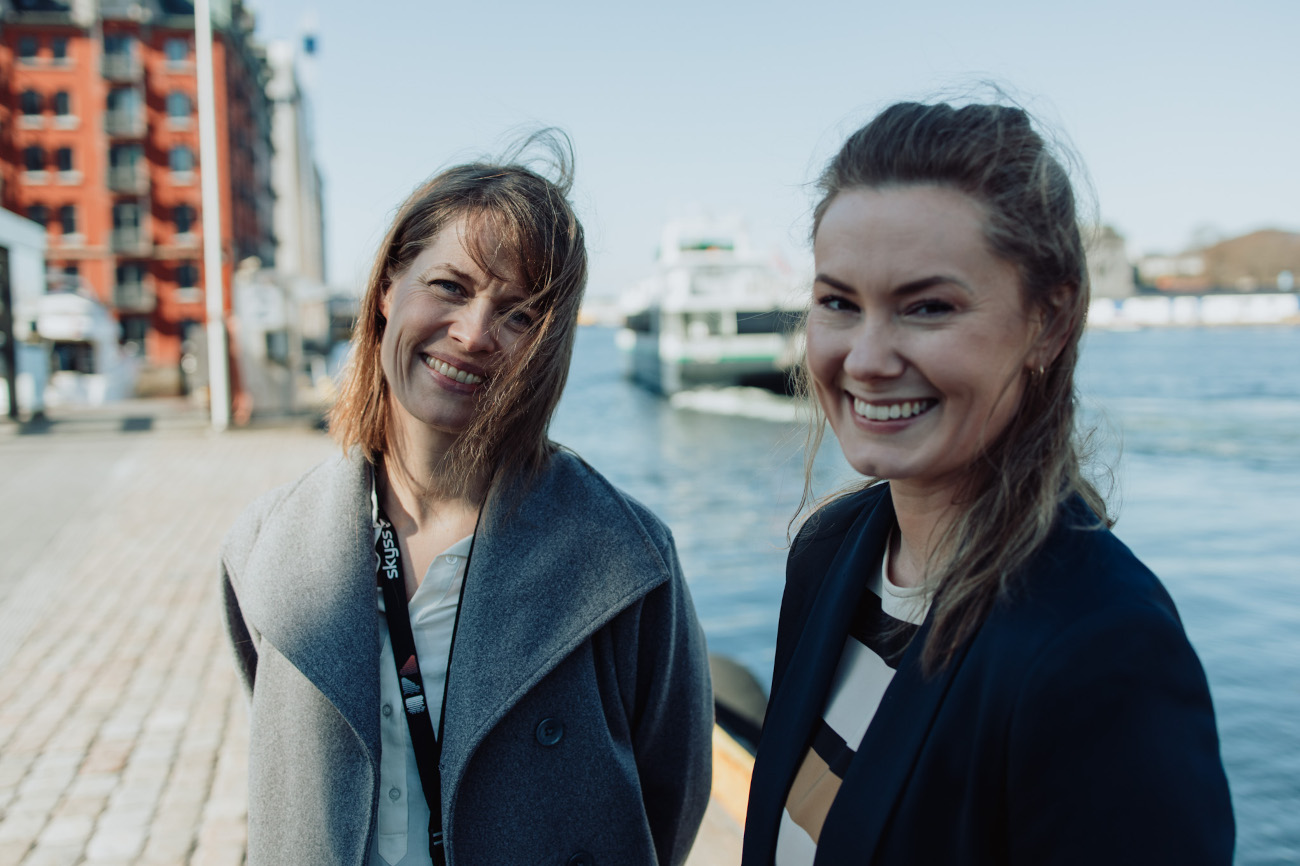
«Our job is to see ghosts in broad daylight,» say Jannike Fredin and Åshild Fossgard Sandøy, project managers in Skyss´ unit for contracts. The unit drives procurement processes and follows up on tender contracts worth billions of kroner.
Ferry and public transport in Vestland are operated by transport companies following tender competitions. Skyss has an extensive task of managing over 30 different transport contracts – 10 for ferries, 11 for buses, and 12 for boats, in addition to taxi contracts for school transport.
Many and Long Processes
Skyss starts preparing new contracts several years before the old ones expire, and the contracts unit is therefore always involved in multiple tender processes.
– The long time horizons are one of the most challenging aspects, says Åshild Fossgard Sandøy, who, together with Jannike Fredin, is the project manager for many of Skyss’s procurement processes.
A general rule for ferries is that preparation must begin at least six years before operations start. For buses, a little less time is needed because the delivery time for buses is shorter.
Hard to Peer into the Crystal Ball
– The world is developing at a rapid pace, but we have to lock in assumptions in contracts many years in advance. We may find that something is under-dimensioned when the contract starts, but this was the best we had when we set the framework seven years ago, explains Sandøy.
– I’ve gained a great understanding of other areas in society. You hear people laugh when new hospitals or elementary schools are too small even at the opening, but they were planned many years before. Now I know how difficult it is to peer into the crystal ball, she says.
Large Effort Across Departments
The contracts unit must lead each procurement project and gather all the facts needed for the tender documentation, such as route times, passenger statistics, connections, school transport needs, considerations about emissions, types of transport modes, and more. Behind this lies extensive assessments, and several units in Skyss work intensively to get the numbers, facts, and analyses ready for the tender announcement.
– Each contract has its own characteristics related to geography, demographics, road standards, weather, waterways, and so on. The contract periods are also long, meaning that there is always change from one contract to the next. A cut-and-paste approach is therefore out of the question, says Sandøy.
A Lot of Money at Stake
The contracts Skyss operates are worth billions. – We need to know what our requirements will cost. Just one sentence about system requirements for buses can increase the contract price by several million, says Jannike Fredin.
At the same time, Skyss is seeing the financial situation tighten. Costs in the transport sector have increased dramatically in recent years due to factors like war and the pandemic. Everything from fuel to the production of new transport vehicles has become more expensive, and exchange rate fluctuations play a major role. Operator companies are operating with narrow margins, and upcoming contracts could become significantly more expensive.
– If the value of a bus contract increases by 30-40 percent, it will give us major financial challenges, points out Fredin.
Electrification Increases Risk
The transition to electric operations for ferries, buses, and boats has required a lot of pioneering work, especially to secure electricity for new charging points at terminals and bus stations.
– Challenges concerning power grid access have increased the risk in contracts. We have to collaborate with many grid companies, which is often unpredictable. We may need to increase preparation time even more – in addition to the years we already need – to ensure that the electricity grid is ready by the start of operations, says Sandøy. If the county municipality is to take more responsibility for such infrastructure, it will require cross-department collaboration.
Professional Paranoia
There are three project managers in the contracts department, and they typically work in pairs.
– The legal assessments are so complex, with huge financial consequences, that we have to be two to discuss everything from many angles, explains Fredin.
– Our job is to see ghosts at broad daylight. We have to draft the contract with the ‘worst-case scenario’ in mind. You almost become paranoid. We work as professional disaster planners, she smiles.
And it doesn’t always seem to work.
– After the problems with the boats in the Florø area, we see even more ghosts. In principle, we could find risks with every single sentence in all contracts. But we can’t create measures for everything. That would increase the price, points out Fredin.
Long Contracts, Short Decision Periods
The County Council has overall responsibility for the transport contracts and their financing. Politicians receive procurement proposals for decisions at specific points in the process, but the long time frames are a clear challenge. The time from the start of a procurement process to the end of the contract period can be as long as 22 years. During this time, the County Council has changed composition five times.
– It is crucial that we manage to communicate to the politicians what a tender process entails, and the consequences of proposed decisions. When we present a case five years before the contract starts, we need the decision to be binding and provide clear guidelines moving forward. A new political decision later in the process can overturn large parts of the requirements in the competition because the requirements are interdependent. If you replace pieces, the puzzle doesn’t fit anymore, says Jannike Fredin.
Åshild Fossgard Sandøy points out that it’s not easy to explain the big picture in a political document, which is ideally under ten pages long, especially since only the summary and recommendation may be read, amidst the sea of other documents.
– A good political case document is short and concise, but much information and many nuances get lost. It’s challenging to find the right balance between the whole picture and the details within the constraints of a political document, says Sandøy.
In the autumn of 2024, Skyss had to change its timeline for transport procurement because there were simply too many contract issues in the air at the same time. For an overview of all ongoing contract processes in Norwegian, click here (PDF, elementscloud.no).

Numbers
and data
| Post | 2024 | 2023 |
|---|---|---|
| Bus | 2 588 958 000 | 2 426 699 000 |
| Light Rail | 337 607 000 | 301 381 000 |
| Boat | 487 902 000 | 456 535 000 |
| Ferry | 1 502 860 000 | 1 274 770 000 |
| School transport | 160 075 000 | 157 294 000 |
| Administration | 242 263 000 | 219 921 000 |
| Gross operating costs | 5 319 665 000 | 4 836 600 000 |
| Post | 2024 | 2023 |
|---|---|---|
| Ticket income, bus and light rail | 882 937 000 | 815 042 000 |
| Ticket income, boat | 54 683 000 | 53 167 000 |
| Ticket income, ferries | 118 107 000 | 155 366 000 |
| School transport, municipal refunds | 224 313 000 | 197 105 000 |
| Reward funds | 417 700 000 | 366 600 000 |
| Other | 46 174 000 | 51 393 000 |
| Total income | 1 743 914 000 | 1 638 673 000 |
| Post | 2024 | 2023 |
|---|---|---|
| Net operating costs, accounting | 3 575 753 000 | 3 197 926 000 |
| Net operating costs, budget | 3 404 136 000 | 3 118 018 000 |
| Difference / additional spending | −171 617 000 | −79 908 000 |
| Contractual area | Route kilometers, 2024 | # of buses / wagons in use |
|---|---|---|
| Austevoll | 406 238 | 10 |
| Sunnhordland | 2 184 546 | 53 |
| Hardanger og Voss | 5 433 512 | 104 |
| Modalen og Vaksdal | 372 160 | 11 |
| Nordhordland | 3 518 198 | 81 |
| Bergen north, incl. Osterøy | 9 121 432 | 153 |
| Bergen south | 6 166 584 | 111 |
| Bergen centre | 6 577 332 | 125 |
| West | 5 472 773 | 134 |
| Service lines in Bergen | 51 052 | 4 |
| Sogn | 2 142 268 | 62 |
| Nordfjord | 1 533 631 | 51 |
| Sunnfjord | 4 641 169 | 139 |
| Sum, bus | 47 620 895 | 1 038 |
| Bergen Light Rail | 2 990 227 | 26 |
| Sum, route kilometers Vestland | 50 611 122 | 1 064 |
| Means of transport | 2020 | 2021 | 2022 | 2023 | 2024 |
|---|---|---|---|---|---|
| Bus | 40 016 000 | 45 786 000 | 57 805 000 | 63 071 000 | 65 079 000 |
| Light rail | 12 425 000 | 13 901 000 | 19 122 000 | 24 288 000 | 25 850 000 |
| Sum, bus and light rail | 52 441 000 | 59 687 000 | 76 928 000 | 87 359 000 | 90 929 000 |
| Boat | 1 167 000 | 1 199 000 | 1 596 000 | 1 762 000 | 1 780 000 |
| Ferry | 4 787 000 | 5 100 000 | 5 238 000 | 5 371 000 | 5 924 000 |
| Sum, all means of transport | 58 395 000 | 65 986 000 | 83 761 000 | 94 492 000 | 98 633 000 |
| Means of transport | 2020 | 2021 | 2022 | 2023 | 2024 |
|---|---|---|---|---|---|
| Bus, Bergen (municipality) | 29 801 000 | 33 546 000 | 43 696 000 | 48 181 000 | 49 725 000 |
| Bus, Bergen (region) | 34 966 000 | 39 885 000 | 51 405 000 | 57 014 000 | 58 735 000 |
| Bus, Vestland except Bergen region** | 6 495 000 | 5 900 000 | 6 400 000 | 6 056 000 | 6 588 000 |
| Bergen Light Rail | 12 424 000 | 13 901 000 | 19 122 000 | 24 288 000 | 25 850 000 |
| Boat Kleppestø–Strandkaien | 433 000 | 435 000 | 588 000 | 657 000 | 685 000 |
| Boat Knarvik–Frekhaug–Strandkaien | 68 000 | 67 000 | 117 000 | 164 000 | 157 000 |
| Boat, Vestland excl. city connections in Bergen | 492 000 | 533 000 | 890 000 | 941 000 | 949 000 |
| Sum, urban growth area, Bergen * | 47 891 000 | 54 288 000 | 71 232 000 | 82 123 000 | 85 427 000 |
| Sum, Vestland | 54 878 000 | 60 721 000 | 78 522 000 | 89 120 000 | 92 964 000 |
Note: In connection with the 2023 annual report, Skyss changed the definition of the area from a contract area for buses to «boarding at the stop level for the basic district.» Figures for years prior to 2023 were also adjusted to provide comparable data. Example: Passengers boarding at Knarvik terminal who take the bus to Bergen bus station are counted as boardings in Alver.
*) The agreement covers the municipalities of Bergen, Askøy, Øygarden, Alver, and Bjørnafjorden.
**) Please note that the counting method has changed from 2023 to 2024. Therefore, 2024 figures are not directly comparable with previous years.
| Category | 2020 | 2021 | 2022 | 2023 | 2024 |
|---|---|---|---|---|---|
| Passengers | 4 787 000 | 5 100 000 | 5 238 000 | 5 371 000 | 5 924 000 |
| Passenger car units | 3 651 000 | 3 910 000 | 4 147 000 | 4 372 000 | 4 512 000 |
| Vehicles | 2 483 000 | 2 733 000 | 2 921 000 | 3 087 000 | 3 183 000 |
| Line | 2020 | 2021 | 2022 | 2023 | 2024 |
|---|---|---|---|---|---|
| Sunnhordland – Austevoll – Bergen | 269 000 | 269 500 | 324 600 | 330 700 | 337 000 |
| Local boat, Austevoll | 16 500 | 16 900 | 16 200 | 13 800 | 14 100 |
| Espevær–Eidesvik | 35 500 | 37 100 | 35 100 | 32 700 | 30 600 |
| Hellesøy–Lyngøy–Hernar | 6 700 | 6 900 | 6 800 | 6 800 | 7 700 |
| Hardangerfjord express | 21 500 | 21 900 | 43 200 | 49 600 | 51 900 |
| Reksteren–Våge–Os | 3 400 | 6 900 | 7 400 | 6 900 | 8 200 |
| Kleppestø – Strandkaien | 433 000 | 434 700 | 588 000 | 656 600 | 685 300 |
| Knarvik–Frekhaug–Bergen | 68 000 | 67 000 | 117 000 | 163 500 | 156 700 |
| Tourism route, Hardanger | 3 300 | 4 200 | 15 000 | 18 000 | 18 600 |
| Osterfjorden* | 1 900 | 2 200 | 2 100 | 1 900 | 2 000 |
| Geitanger–Knappskog * | 2 100 | 2 200 | 2 200 | 2 300 | 2 200 |
| Total, boat lines in Hordaland | 860 900 | 869 500 | 1 157 600 | 1 282 800 | 1 314 300 |
| Kaupanger–Frønningen | 1 700 | 1 300 | 2 300 | 2 900 | 2 300 |
| Vik–Ortnevik–Måren–Nordeide | 22 000 | 22 400 | 23 700 | 23 200 | 19 000 |
| Måløy–Silda / Måløy–Gangsøy – Risøy | 3 700 | 5 800 | 5 200 | 4 000 | 5 000 |
| Kystvegekspressen (Måløy–Smørhamn–Florø) | 9 700 | 10 900 | 12 800 | 12 600 | 9 800 |
| Gulen / Solund | 18 000 | 23 200 | 22 300 | 24 100 | 25 900 |
| Local routes, Florø and outlying islands | 96 200 | 100 700 | 102 100 | 105 300 | 95 300 |
| Total, boat lines in Sogn og Fjordane | 151 300 | 164 300 | 168 400 | 172 100 | 157 300 |
| Bergen–Nordfjord | 112 900 | 118 700 | 162 100 | 169 000 | 173 900 |
| Bergen–Sogn | 35 400 | 38 500 | 55 800 | 61 700 | 62 800 |
| Bergen–Flåm | 6 200 | 8 100 | 52 200 | 76 400 | 83 100 |
| Total, lines Bergen – Sogn og Fjordane | 154 500 | 165 300 | 270 100 | 307 100 | 319 800 |
| Total, boat lines, Vestland* | 1 167 000 | 1 199 000 | 1 596 000 | 1 762 000 | 1 791 400 |
| Total, city connection lines, Bergen | 501 000 | 501 700 | 705 000 | 820 100 | 842 000 |
| Total, boat lines outside of the Bergen area | 665 700 | 697 400 | 891 100 | 941 900 | 949 400 |
| Line | Vehicles excl. MC, 2023 | Passenger car units, 2023 | Passengers, 2023 | Vehicles excl. MC, 2024 | Passenger car units, 2024 | Passengers, 2024 |
|---|---|---|---|---|---|---|
| 1019 Masfjordnes – Duesund | 71 799 | 84 635 | 111 820 | 71 714 | 82 792 | 108 899 |
| 1020 Hatvik – Venjaneset | 398 748 | 534 070 | 724 423 | 428 912 | 565 468 | 809 052 |
| 1021 Halhjem – Våge | 202 412 | 254 745 | 370 358 | 213 347 | 269 025 | 395 847 |
| 1022 Krokeide – Hufthamar | 375 378 | 502 832 | 555 243 | 395 857 | 553 865 | 644 369 |
| 1023 Husavik – Sandvikvåg | 76 709 | 101 142 | 152 923 | 79 012 | 102 969 | 154 479 |
| 1024 Kvanndal – Utne | 87 032 | 162 412 | 174 058 | 81 567 | 154 042 | 163 600 |
| 1025 Kinsarvik – Utne | 21 519 | 29 072 | 58 385 | 19 974 | 26 454 | 49 187 |
| 1026 Jondal – Tørvikbygd | 288 942 | 439 665 | 488 660 | 295 236 | 450 239 | 560 623 |
| 1027 Gjermundshamn – Varaldsøy – Årsnes | 241 733 | 355 579 | 465 542 | 238 095 | 354 983 | 476 291 |
| 1028 Fedje – Sævrøy | 58 574 | 70 630 | 101 568 | 62 400 | 75 595 | 116 619 |
| 1029 Leirvåg – Sløvåg | 243 453 | 406 684 | 370 048 | 247 851 | 405 523 | 370 239 |
| 1030 Langevåg – Buavåg | 79 169 | 105 956 | 124 446 | 83 510 | 114 296 | 127 272 |
| 1031 Skånevik – Matre – Utåker | 62 939 | 100 752 | 116 969 | 61 337 | 96 172 | 113 838 |
| 1032 Skjersholmane – Ranavik | 207 315 | 326 007 | 348 242 | 224 264 | 348 332 | 376 269 |
| 1033 Jektevik – Nordhuglo – Hodnanes | 209 333 | 272 481 | 304 894 | 209 673 | 272 060 | 356 865 |
| 1034 Fjelberg – Sydnes – Utbjoa | 27 778 | 40 215 | 78 940 | 26 671 | 37 915 | 76 548 |
| 1035 Klokkarvik – Lerøy – Bjelkarøy – Hjellestad | 29 651 | 33 712 | 107 985 | 33 084 | 37 148 | 122 714 |
| 1037 Barmen – Barmsund | 4 924 | 5 763 | 7 687 | 5 838 | 6 263 | 10 516 |
| 1038 Stårheim – Isane | 121 271 | 174 183 | 208 860 | 123 993 | 182 628 | 212 194 |
| 1039 Måløy – Husevågøy – Oldeide | 70 391 | 99 807 | 185 347 | 73 918 | 105 824 | 224 157 |
| 1041 Daløy – Haldorsneset | 27 765 | 35 212 | 43 244 | 25 069 | 31 957 | 40 614 |
| 1042 Rysjedalsvika – Rutledal – Krakhella | 54 726 | 80 134 | 86 685 | 58 889 | 85 646 | 176 743 |
| 1043 Hisarøy – Mjånes | 4 847 | 5 089 | 7 373 | 4 863 | 4 994 | 7 388 |
| 1140 Askvoll – Gjervik – Fure – Askvoll | 83 238 | 99 099 | 141 155 | 89 043 | 107 937 | 167 679 |
| 1141 Askvoll – Fure – Værlandet | 27 655 | 39 221 | 36 218 | 28 403 | 40 129 | 61 782 |
| Line | Regularity | Regularity excl. force majeure | Delays in % |
|---|---|---|---|
| Barmen–Barmsund | 97.17 % | 97.17 % | 0.00 % |
| Daløy–Haldorsneset | 100.00 % | 100.00 % | 0.00 % |
| Mjånes–Hisarøy | 100.00 % | 100.00 % | 0.00 % |
| Askvoll–Gjervik–Fure | 99.46 % | 99.50 % | 2.25 % |
| Isane–Stårheim | 99.07 % | 99.72 % | 0.51 % |
| Måløy–Oldeide–Husevågøy | 98.56 % | 100.00 % | 4.35 % |
| Rysjedalsvika–Rutledal–Losna–Krakhella | 99.75 % | 99.96 % | 14.66 % |
| Leirvåg–Sløvåg | 99.19 % | 99.31 % | 0.60 % |
| Fedje–Sævrøy | 99.80 % | 99.80 % | 3.08 % |
| Hufthamar–Krokeide | 99.91 % | 99.91 % | 0.30 % |
| Husavik–Sandvikvåg | 100.00 % | 100.00 % | 9.97 % |
| Hatvik–Venjaneset | 99.65 % | 99.98 % | 3.69 % |
| Halhjem–Våge | 99.81 % | 99.81 % | 6.19 % |
| Langevåg–Buavåg | 99.14 % | 99.90 % | 0.73 % |
| Jektavik–Nordhuglo–Hodnanes | 99.46 % | 99.63 % | 12.22 % |
| Ranavik–Skjersholmane | 99.71 % | 99.77 % | 2.29 % |
| Gjermundshavn–Varaldsøy–Årsnes | 99.65 % | 99.91 % | 6.51 % |
| Jondal–Tørvikbygd | 99.43 % | 99.50 % | 0.54 % |
| Klokkarvik–Hjellestad | 99.47 % | 99.50 % | 2.52 % |
| Fjellbergsambandet | 99.74 % | 99.74 % | 2.94 % |
| Kinsarvik–Utne | 99.72 % | 99.94 % | 0.22 % |
| Kvanndal–Utne | 100.00 % | 100.00 % | 0.80 % |
| Skånevik–Matre–Utåker | 99.81 % | 99.71 % | 0.58 % |
| SUM Vestland | 99.54 % | 99.77 % | 2.60 % |
Contracts
| Contract | Duration | Type of contract | Operator |
|---|---|---|---|
| Bergen sør, incl. Os og Austevoll | 16.08.2019 – 25.06.2028 (1+1) | Gross | Tide Buss AS |
| Bergen sentrum | 01.12.2020 – 30.06.2030 (1+1) | Gross | Tide Buss og Bane AS |
| Bergen nord, incl. Osterøy og service lines | 01.10.2020 – 30.06.2030 (1+1) | Gross | Tide Buss AS |
| Vest (Øygarden / Askøy) | 25.06.2019 – 25.05.2028 (+1+1) | Gross | Tide Buss AS |
| Nordhordland | 16.08.2018 – 15.08.2027 | Gross | Vy Buss AS |
| Sunnhordland | 02.07.2017 – 28.06.2026 | Gross | Tide Buss AS |
| Hardanger / Voss | 16.08.2016 – 22.06.2025 | Gross | Tide Buss AS |
| Modalen / Vaksdal | 16.08.2016 – 22.06.2025 | Gross | Modalen – Eksingedalen Billag AS |
| Sogn | 19.06.2017 – 22.06.2026 | Gross | Tide Buss AS |
| Sunnfjord | 20.06.2016 – 23.06.2026 | Gross | Firda Billag AS |
| Nordfjord | 23.06.2014 – 19.06.2026 | Gross | Firda Billag AS |
| Line | Duration until | Type of contract | Operator |
|---|---|---|---|
| 1037 Barmen–Barmsund | 31.10.2026 | Net | Vidar Hop Skyssbåter AS |
| 1038 Stårheim–Isane | 31.10.2026 | Net | Fjord1 |
| 1039 Måløy–Husevågøy–Oldeide | 31.10.2026 | Net | Fjord1 |
| 1040 Askvoll–Gjervik–Fure–Værlandet* | 31.10.2026 | Net | Fjord1 |
| 1041 Daløy–Haldorsneset | 31.10.2026 | Net | Gulen Skyss AS |
| 1042 Rysjedalsvika–Rutledal–Krakhella | 31.10.2026 | Net | Fjord1 |
| 1043 Hisarøy–Mjånes | 31.10.2026 | Net | Wergeland AS |
| 1140 Askvoll–Gjervik–Fure–Askvoll | 31.10.2026 | Net | Fjord1 |
| 1141 Askvoll–Fure–Værlandet | 31.10.2026 | Net | Fjord1 |
| 1020 Hatvik–Venjaneset | 31.12.2028 | Gross | Fjord1 |
| 1021 Halhjem–Våge | 31.12.2028 | Gross | Fjord1 |
| 1022 Krokeide–Hufthamar | 31.12.2029 | Gross | Fjord1 |
| 1023 Husavik–Sandvikvåg | 31.12.2028 | Gross | Fjord1 |
| 1028 Fedje–Sævrøy | 31.12.2028 | Gross | Fjord1 |
| 1029 Leirvåg–Sløvåg | 31.12.2028 | Gross | Fjord1 |
| 1030 Langevåg–Buavåg | 31.12.2028 | Gross | Fjord1 |
| 1026 Jondal–Tørvikbygd | 31.12.2028 | Gross | Fjord1 |
| 1027 Gjermundshamn–Varaldsøy–Årsnes | 31.12.2028 | Gross | Fjord1 |
| 1032 Skjersholmane–Ranavik | 31.12.2028 | Gross | Fjord1 |
| 1033 Jektevik–Nordhuglo–Hodnanes | 31.12.2028 | Gross | Fjord1 |
| 1034 Fjelberg–Sydnes–Utbjoa | 31.12.2028 | Gross | Norled |
| 1035 Klokkarvik–Lerøy–Bjelkarøy–Hjellestad | 31.12.2028 | Gross | Norled |
| 1019 Masfjordnes–Duesund | 31.12.2028 | Gross | Wergeland AS |
| 1024 Kvanndal–Utne | 31.12.2028 | Gross | Boreal Sjø |
| 1025 Kinsarvik–Utne | 31.12.2028 | Gross | Boreal Sjø |
| 1031 Skånevik–Matre–Utåker | 31.12.2028 | Gross | Boreal Sjø |
| Contract | Duration | Type of contract | Operator |
|---|---|---|---|
| Sunnhordland–Austevoll–Bergen Local routes Austevoll | 01.01.2014 – 31.12.2027 | Gross | Norled AS |
| Espevær–Eidesvik Hellesøy–Lyngøy–Hernar | 01.01.2014 – 31.12.2027 | Net | GulenSkyss AS |
| Rosendal–Bergen Reksteren–Våge–Os | 01.01.2014 – 31.12.2027 | Net | L. Rødne & Sønner AS |
| City connection boats, Bergen | 01.01.2023 – 19.01.2025 | Gross | Norled AS |
| City connection boats, Bergen | 20.01.2025 – 15.01.2040 | Gross | Fjord1 AS |
| Tourism route Hardanger (Norheimsund–Eidfjord, summer route) | 01.05.2020 – 30.09.2026 | Net | Norled AS |
| Local route Geitanger–Knapskog | 01.07.2019 – 01.07.2026 | Net | Geitanger Transport AS |
| Local route Osterfjorden | 01.08.2019 – 31.07.2026 | Net | Osterøy Ferjeselskap AS |
| Bergen–Nordfjord / Sogn Nordfjord–Bergen Sogn–Bergen Bergen–Flåm (summer route) | 01.05.2022 – 30.11.2026 | Net | Norled AS |
| Local routes Gulen and Solund Gulen–Ytre Solund Hardbakke–Nåra–Mjømna Hardbakke–Kolgrov–Utvær Gåsvær–Midtre Solund–Hardbakke Nord-Solund | 01.05.2022 – 24.06.2029 (1+1) | Gross | Vidar Hop Skyssbåt AS |
| Local routes in Sogn og Fjordane Florøbassenget (north / south / west) Måløy–Silda / Måløy–Gangsøy–Risøy Vik–Ortnevik / Ortnevik–Måren–Nordeide Kaupanger–Frønningen | 01.05.2024 – 30.04.2036 (+ up to 2 years) | Gross | Norled AS |
| Kystvegekspressen Florø–Smørhamn–Måløy–Selje | 01.05.2024 – 30.04.2025 (+ up to 2 years) | Gross | Norled AS |
| Goods route Bergen–Gulen, Solund og Askvoll | 16.08.2022 – 15.08.2027 (2+2) | Net | Vidar Hop Skyssbåt AS |
Photos
Light Rail and Buses in central Bergen: Sandor Dahl, Åsane Tidende
Ferry: Morten Wanvik
Kronstad Light Rail Stop: Iver Daaland Åse, Bybanen Utbygging
On-Demand Bus in Samnanger: Roy Gunnar Blommedal, Skyss
Art at the Light Rail Stop: Ingrid Dreyer, Skyss
Travelers: Morten Wanvik
The Light Rail in Winter: Morten Wanvik
Vestlandshuset: Karoline Rage, Skyss
Åshild Fossgard Sandøy and Jannike Fredin: Øyvind Strømmen, Skyss
Illustration photo from boat in the Florø area: Øyvind Strømmen, Skyss